
Paying for What Lasts
Thirty years of European ecosystem funding versus Australia's Big-Ag wager
Stand in an alpine meadow above Salzburg in July and you are surrounded by 50 or 60 plant species in a single hectare. Orchids, arnica, eyebright, wild thyme. The farmer who manages that meadow cuts it once a year — late, after the wildflowers set seed — hauls the hay down by hand because the slope is too steep for machinery, and receives a payment from the Austrian government for doing exactly that. Not as charity. As compensation for a service the rest of society benefits from but rarely pays for directly: a functioning, species-rich landscape that holds water in the soil, holds carbon in the vegetation, holds tourists in the valley, and holds genetic diversity in the bank for everything that comes after us.
That farmer has been receiving that payment, in one form or another, since 1993.
What We Mean When We Say “Ecosystem Services”
The phrase has been laundered through enough corporate sustainability reports to make most people’s eyes glaze over. But the underlying idea is straightforward: land that is farmed well does things beyond producing food. It filters water. It sequesters carbon. It maintains the habitat that pollinators, birds and soil organisms need. It prevents erosion. It holds up traditional landscapes that entire regional economies — tourism, recreation, cultural identity — depend on. These are real services that real people benefit from. The question is who pays for them.
The default answer in most industrial agricultural systems is: nobody. The farmer bears the cost of managing land carefully while the market only prices the carrot or the kilogram of grain. The ecological work is invisible on the balance sheet, so the incentive is to stop doing it — to strip the hedgerows, drain the wetlands, apply more herbicide, and run the farm lean.
Europe has, imperfectly but persistently, tried to fix that accounting error for more than three decades.
Thirty Years of Paying Farmers to Steward Land
The first serious attempt came with the 1992 MacSharry reform of the EU’s Common Agricultural Policy (CAP). Under Regulation 2078/92, member states were required — for the first time — to offer voluntary agri-environment measures (AEMs): five-year contracts paying farmers to change how they managed land. Reduce chemical inputs. Maintain traditional grasslands. Set aside land for wildlife. It was underfunded, inconsistent across countries, and often poorly monitored. But the architecture was there: the principle that farmers could be compensated, not just for production, but for ecological stewardship.
Over the following 30 years, that architecture became load-bearing.
Austria: Where 74% of Farms Signed Up
Austria’s ÖPUL programme — the Agrar-Umwelt-Programm — is one of the most thoroughly adopted agri-environment schemes anywhere in the world. Currently, 74.6% of all Austrian agricultural holdings participate, managing 89% of the country’s total agricultural area. In 2023, the programme created or maintained 210,000 hectares of biodiversity areas, covering close to 10% of the entire utilised agricultural area.
The alpine meadow management that makes those July walks possible is one of its centrepieces. Farmers receive payments for maintaining Artenreiches Grünland — species-rich grassland — and for managing mountain meadows and alpine pastures in ways that maintain their botanical diversity. The results, tracked through more than a decade of monitoring, show that on over 80% of monitoring plots in extensive grassland, the number of observed species has remained stable or increased.
This matters because the Austrian Alps are not just a nature reserve. They are a working agricultural landscape whose value to tourism, flood prevention and water supply is substantial. The farms that manage them are also, in effect, managing infrastructure that the broader economy depends on. The ÖPUL payment acknowledges that. It makes the invisible service visible in the ledger.
Switzerland: Making It a Condition, Not Just an Option
Switzerland took the logic one step further. Since 1993, Swiss farmers have been required — as a condition for receiving any direct payments — to implement a set of ecological practices. Since 1999, access to the full payment has depended on managing at least 7% of the farm’s utilised agricultural area as biodiversity promotion areas (BPAs): wildflower strips, hedgerows, extensively managed meadows, or similar habitat.
More recently, Switzerland shifted toward result-based payments for some measures — compensating farmers not for following a prescribed management practice but for actually achieving measurable ecological outcomes. A 2025 study published in the American Journal of Agricultural Economics and summarised by Agroscope found that result-based payment reforms drove measurable biodiversity improvements — specifically on farms whose land was close to but just below the quality threshold, where the payment signal gave farmers a meaningful incentive to improve. The finding provides empirical support for the design principle: payments that target outcomes rather than prescribed management steps can trigger genuine ecological change.
That is a significant shift in philosophy. Instead of the state telling the farmer how to farm, it tells the farmer what the land should look like by the end of summer, and trusts the farmer to figure out how to get there. Thirty years in, Swiss direct payment participation is near-universal, and the biodiversity baseline in Swiss farming regions substantially exceeds that in neighbouring countries with purely production-focused support.
France: Scale, Contracts, and the Natura 2000 Backbone
France receives the largest share of any EU member state from the Common Agricultural Policy — €9.5 billion in 2023 from the two main funds combined. A significant portion flows through its Mesures Agro-Environnementales et Climatiques (MAEC): multi-year contracts, typically five years, through which farmers commit to specific ecological management practices and receive compensation for the income foregone and the additional costs incurred.
The French system is substantially integrated with the Natura 2000 network — the EU’s framework for protecting critical habitats and species across member states. Farmers in and around Natura 2000 sites can access specifically targeted contracts for managing habitat. The combination of the site-protection framework and the payment mechanism is designed to keep farming viable in ecologically sensitive areas, rather than having those areas either abandoned or intensified.
France’s implementation has not been without critique. Environmental assessors have consistently found that the country’s overall CAP Strategic Plan is not ambitious enough, and that biodiversity indicators continue to decline in many agricultural regions despite decades of intervention. That critique is worth holding. Agri-environment payments have slowed losses, not reversed them everywhere. The policy instrument exists; the question is whether it is deployed at sufficient scale and designed rigorously enough to change outcomes rather than just offset guilt.
But the baseline — 30 years of contract-based payments, a Natura 2000 network, an obligation to allocate 25% of direct payments to eco-schemes under the current 2023–2027 CAP — represents a fundamentally different relationship between land, farming and public money than anything operating in Australia.
Italy: From Compliance to Calculation
Italy’s experience parallels France’s: the 1992 reform, the Reg. 2078/92 measures, the gradual deepening of the programme through successive CAP periods. What is particularly interesting is what has happened in regions like Trentino, where the Rural Development Programme management authority has moved beyond simple compliance measures to integrate a full ecosystem services calculation into how agri-environment-climate payments are set.
Rather than asking “what does it cost a farmer to not spray this hedgerow?”, the Trentino approach asks: “what is the value of the ecosystem services this hedgerow actually provides?” — flood attenuation, pollination, carbon storage, landscape aesthetics — and uses that valuation to set the payment level. It is early work, but it points toward a more honest accounting: one where the payment reflects the genuine value of what is being maintained, not just the administrative cost of the management requirement.
The Budget Behind the Words
Numbers matter here. The EU’s current CAP cycle, covering 2023 to 2027, allocates €44.7 billion specifically for eco-schemes — the voluntary environmental top-up payments under Pillar I — out of a total Pillar I budget of €190 billion. Every member state must allocate at least 25% of its direct payments to eco-schemes. Under Pillar II, the Rural Development Programme contains separate agri-environment-climate measures running into further billions across member states.
Viewed in isolation, €44.7 billion is a substantial public investment and amounts to approximately €8.9 billion per year—around 0.05% of the EU’s €16–17 trillion GNP.
When placed alongside the potential value of ecosystem services, the scale of investment appears remarkably modest. The landmark study by Robert Costanza and colleagues (1997 ) estimated that the world’s ecosystems generated approximately US$33 trillion annually in services at a time when global GNP was about US$18 trillion, suggesting that ecological systems contributed value equivalent to roughly 1.8 times measured global economic output. The significance of the study was not the precise figure, but the demonstration that a substantial share of human welfare depends upon ecological functions that conventional economic accounts largely overlook.
If that relationship is applied illustratively to the European economy, ecosystem services would represent a value on the order of €28–30 trillion annually. Whether or not the precise figure is accepted, the implication is clear: if even a fraction of that value depends upon healthy soils, functioning watersheds, biodiversity, pollination, and climate regulation, then allocating €8.9 billion or around 0.05% of annual economic output to support those systems appears a relatively modest form of environmental or societal risk management.
Seen in this light, Europe’s eco-scheme budget appears less as a farmer subsidy than as an investment in maintaining productive natural capital. Whether the current level of expenditure is sufficient remains an open question. What is clear is that the CAP reflects a significant institutional shift: an explicit recognition that public goods regenerated by farmers and landscapes have economic value even when markets fail to reward them.
The CAP eco-scheme mechanisms remain imperfect. Payments are often prescriptive rather than outcome-based, monitoring can be limited, and the scale of investment remains small relative to both the economy it supports and the ecological assets it seeks to maintain. Nevertheless, the principle is now embedded in European agricultural policy: if ecosystem services underpin human welfare and economic production, then public investment in their stewardship is not an exception to sound economic policy—it is a necessary part of it.
Australia’s Ledger
Australia’s farming sector is frequently described as among the least subsidised in the world. Government support accounts for roughly 2–3% of farm receipts, compared with around 16% in the European Union under CAP. This is presented, in official documents and farming lobby communications, as a point of pride — evidence of resilience, efficiency, self-reliance.
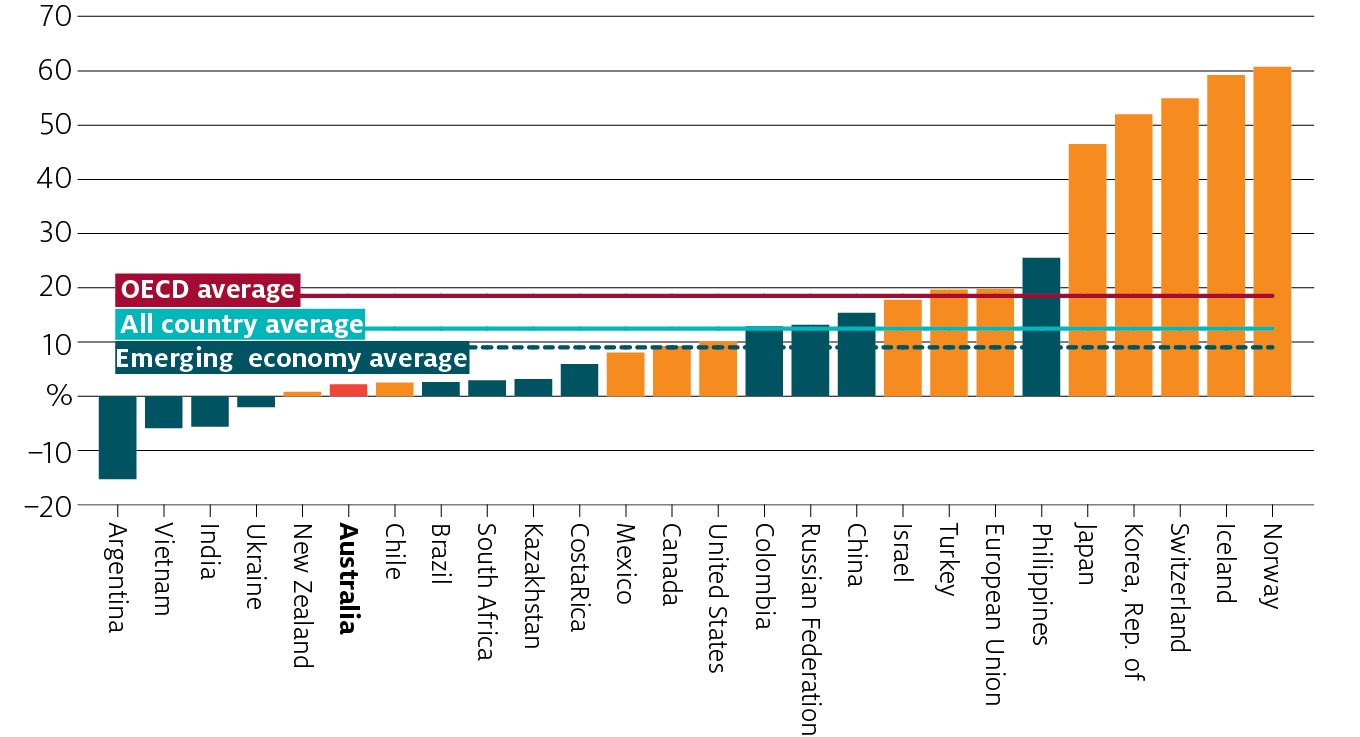
What the 2% figure does not capture is the environmental cost that the market never prices and the public eventually pays.
Australian agriculture consumes approximately 70% of the country’s available water resources. Soil erosion in intensively farmed areas runs at five tonnes per hectare per year in some regions — roughly five times the tolerable rate at which soil naturally forms (approximately one tonne per hectare per year). Herbicide use in the grains industry has increased more than 65% in the decade from 2014 to 2024, at a cost exceeding AUD $2.5 billion per year. Roughly two million hectares of farmland carry the legacy of dryland salinity — the figure from the last comprehensive national survey (2002), now considered an undercount given that Western Australia alone reports up to two million hectares affected. The cause is the predictable result of removing deep-rooted native vegetation across the wheatbelt in the mid-20th century.
Agriculture accounts for around 17–18% of Australia’s total greenhouse gas emissions. The species extinction rate in agricultural landscapes remains among the highest for any developed country. The rangelands — over half of Australia’s land mass — show persistent degradation from overgrazing: loss of perennial grasses, woody weed encroachment, changed water infiltration.
None of these costs appear in the 2% figure. They are borne by the land, by the rivers, by future landholders, by the public health system, and by the species that do not get a vote.
The federal government’s principal response has been the Climate-Smart Agriculture Program — a $302 million, five-year investment focused primarily on R&D and productivity improvement. The Biodiversity Council’s analysis of the 2025–26 federal budget found that investment in agricultural stewardship and biosecurity programs that benefit biodiversity had been cut by a third, from $27.9 million in 2024–25 to $18.1 million in 2025–26.
Europe has embedded ecosystem payments into agricultural policy at a scale equivalent to around 0.05% of national income each year; Australia is moving toward 0.0006%. The difference is not merely one of budget size; it reflects fundamentally different assessments of the economic value of ecological stewardship.
The Ideology Behind the Gap
This divergence is not merely an accident of fiscal policy. It reflects a deeper difference in how agricultural value is understood.
For several decades, Australian agricultural policy has been shaped by the view that competitive markets are the most efficient mechanism for allocating resources and that government intervention should be limited to correcting only the most obvious failures. Within this framework, the claim that Australian farmers are “unsubsidised” becomes a point of pride: evidence that agricultural productivity is being driven by market discipline rather than public support.
There is a further irony in this approach. The retreat from income stabilisation, supply management, and other forms of agricultural intervention was often justified as a rejection of the “nanny state” in favour of market discipline. Yet farmers do not operate in textbook competitive markets. They purchase fertiliser, chemicals, machinery, seed, finance, and technology from increasingly concentrated industries, while selling into supply chains dominated by a relatively small number of processors, exporters, supermarkets, and commodity traders. In economic terms, many agricultural markets are characterised by monopoly or oligopoly power on the selling side and monopsony or oligopsony power on the buying side.
The result is that the removal of public mechanisms designed to stabilise farm incomes did not necessarily create freer markets. In many cases it simply shifted bargaining power away from farmers, who are also the environmental steward. The gains from productivity growth, technological innovation, and scale efficiencies have often been captured elsewhere in the supply chain, leaving farmers squeezed between rising input costs and limited pricing power. Environmental stewardship then becomes yet another unfunded obligation imposed on businesses that frequently lack the market power needed to recover its cost.
The difficulty is that many of the most important outputs of agricultural landscapes are not commodities. Clean water, biodiversity, carbon storage, pollination, soil formation, flood mitigation, and landscape resilience are valuable precisely because their benefits extend beyond the farm gate. The farmer who maintains native vegetation, protects riparian zones, or manages grazing pressure to preserve soil structure creates value for downstream communities, neighbouring landholders, future generations, and ecosystems. Yet only a small fraction of that value can be captured through market transactions.
This is the classic problem of public goods and positive externalities. The benefits are widely shared, while the costs are borne privately. A farmer who maintains a native vegetation corridor, or who keeps traditional grassland unploughed, or who manages grazing pressure to protect soil structure — that farmer cannot capture most of the value they create. Value flows to neighbouring farms, to downstream water users, to tourism operators, to the atmosphere, to species that will persist for the next generation. Without a payment mechanism, the rational short-term choice is to stop doing it. The market does not fix this. It accelerates it.
Under these conditions, even well-functioning markets systematically under-reward stewardship. In agricultural markets characterised by unequal bargaining power, the problem is magnified: farmers are expected to maintain natural capital while possessing little ability either to charge for the ecological value they create or to pass stewardship costs through the supply chain.
Beginning with the CAP reforms of the early 1990s, Europe gradually incorporated this insight into agricultural policy. The principle was straightforward: where farmers generate public environmental benefits, public investment can legitimately help support their provision. The implementation has often been imperfect, but the underlying logic represents an attempt to align private incentives with public value.
Australia has, by and large, refused that correction. The off-ramps exist: the Biodiversity Offsets Scheme in NSW generates some stewardship agreements; the previous government’s Agriculture Stewardship Package showed what direct payment mechanisms could look like. But these are margin notes compared with the main text, which remains production volume, export competitiveness, and the minimisation of private costs. Ecological stewardship is encouraged rhetorically, but only rarely rewarded at a scale commensurate with the value it creates.
What This Actually Means on the Ground
The Austrian farmer cutting the alpine meadow by hand in late July is not a nostalgic holdover. She is a rational actor responding to a payment signal that values her ecological management. Remove the payment, and the economically rational choice becomes obvious: convert the steep meadow to something manageable by machine, or abandon it. Within a generation, the botanically rich grassland — the result of centuries of management — is scrub. The wildflowers are gone. The tourists go elsewhere. The water regulation changes. The genetic diversity is written off.
The farmer doesn’t want this. Nobody wants this. But without a payment mechanism that reflects the actual value of stewardship, the system selects for its own degradation.
This is not a romantic argument about preserving the past. It is a practical argument about what the land is actually worth, and who pays for it.
Australia has enormous agricultural landscapes — rangelands, dryland farming zones, coastal floodplains — that are providing ecological services right now: carbon storage, water filtration, habitat, erosion control. Those services are going uncompensated. The result, predictably, is that they are being degraded.
Making Stewardship Legible
The underlying challenge — the one that ÖPUL, Switzerland’s results-based payments, and Italy’s Trentino approach are each grappling with in different ways — is measurement. You cannot compensate what you cannot verify. For the first 20 years of European agri-environment schemes, verification meant compliance: did the farmer follow the prescribed management practice? Did they cut the meadow late enough? Leave the wildflower strip unploughed? The payments were tied to behaviour, because behaviour was what inspectors could observe.
The shift toward results-based payments — where compensation depends on what the land actually becomes, not just what the farmer did — requires something more demanding. You need to measure the meadow itself. Count the plant species. Track the pollinators. Assess the soil biology. And you need that measurement to be auditable, portable, and comparable across farms and years. This requires an accounting system that treats ecological valueflow events as first-class data, structurally equivalent to monetised economic ones — not a bolt-on reporting function, but a native part of how the farm’s activity is recorded.
Most farm management software does not do this. Accounting systems log inputs when purchased, harvests when wages or contract fees are paid, and outputs when sold. That quantities record, when it exists at all, lives in a separate system — a different app, a consultant’s spreadsheet, the sensor manufacturer’s cloud — and cannot be cross-referenced with the monetised record without manual effort. The ecological record — soil health data, nitrate runoff, carbon sequestration, biodiversity ledgers, yield and nutrient density data — lives in a different world from economic accounts: that of environmental scientists, not farmers, when it is recorded at all. That separation is not a technical accident. It reflects an accounting philosophy that treats nature as free, unlimited in supply, a set of conditions under which economic activity occurs, rather than as a participant in it.
GrowGood is built on a different model. At the foundation is Valueflows
— an open standard for describing economic activity using the Resources–Events–Agents (REA) accounting framework developed by Professor William McCarthy (1982) and extended by Lynn Foster, Bob Haugen and others. In REA accounting, every meaningful act in an economy is an vf:EconomicEvent that involves vf:Agents (participants with a stake in the outcome, including ecological agents like lakes or forests) and changes in vf:EconomicResources (anything agents want to account for). The model was originally designed for human economic networks — cooperatives, food hubs, supply chains. But it is neutral on what kind of valueflow is at stake, which turns out to be exactly what ecological accounting needs.
Alongside Valueflows, GrowGood integrates the W3C SOSA ontology
— the open standard for sensor observations. The result is that a soil carbon reading from an IoT probe and a harvest record logged by the farmer live in the same linked-data graph, structurally connected. A sosa:Observation of soil organic carbon sits in the same data structure as a vf:EconomicEvent for a cattle sale, cross-referenceable and portable. When you want to understand whether regenerative grazing is building soil carbon, or whether the late-cut meadow is actually supporting a richer pollinator community, the ecological context is already part of the economic record — not siloed in a different system.
This is what Trentino has been attempting to do at the policy level, using pen and consultant reports. The GrowGood ecosystem-services-patterns vocabulary extension does it in code: carbon sequestration valued using the social cost of carbon; water regulation and quality quantified at the watershed scale; biodiversity tracked using Shannon diversity index and species abundance counts; pollination services modelled with beneficiary identification — the extension links each ecosystem service to the specific resources and economic actors that receive it. In a reference scenario for a regenerative beef operation, these patterns produce an auditable AUD $28,500 in annual ecosystem services value, sitting alongside the conventional cattle sales in the same economic record. The meadow management becomes computable. The stewardship can be priced.
Nature at the Table
Dig into the vocabulary that GrowGood uses to model regenerative land processes and something philosophically significant surfaces. The core Valueflows vocabulary
describes a vf:Process that transforms input resources into output resources, or modifies resources, or transfers resources, or transports resources from one agent to another. For example, a farmer (vf:Agent) could plant a field (vf:Process), consuming seeds and water, and using a tractor, producing a field of plants (input and output vf:EconomicEvents and vf:EconomicResources). The river next to that field could be considered an ecological agent in its own right (vf:Agent), perhaps when the irrigation water runs from the field into the river, it introduces excess nitrates (vf:EconomicEvent and vf:EconomicResource) into the river, triggering a dangerous ecological process known as eutrophication (vf:Process). This surge in nutrients stimulates explosive algae and cyanobacteria growth, depleting oxygen and producing toxins that threaten aquatic life and drinking water supplies (input and output vf:EconomicEvents and vf:EconomicResources). These are processes, good or bad, where the river itself is the primary actor. Other ecological agents might be a grassland that sequesters carbon; a restored wetland enhancing water filtration; a re-established native corridor restoring pollinator habitat. In the VF data model, these are not passive measurements of what happened to a resource — they are economic events in which the ecosystem is the agent of change.
In standard REA accounting, an agent is a human person or organisation that participates in economic events. This is a reasonable starting assumption for a system designed to model human enterprise networks. But it encodes a particular worldview: that nature is a stock of resources, a background condition, an asset on the balance sheet — managed by human agents, not a participant in its own right. The ecological agent extensions in GrowGood push against this boundary. When a mycorrhizal network delivers phosphorus to plant roots, something of economic value has been transferred. When native understorey vegetation prevents erosion that would otherwise cost downstream infrastructure, a service has been rendered. When a flowering roadside hedge supports a hive that pollinates the orchard — and the extension model records that pollination event with both the provider (the hedge, the bee colony) and the beneficiary (the orchard) — the accounting is one step closer to representing the ecological transaction honestly.
The formal vocabulary for representing nature as a named vf:Agent — a party with a recognised stake in economic outcomes — is not yet fully developed, and the GrowGood project is candid about this as a frontier. Doing it properly would mean reaching for conceptual and legal frameworks that are still being built. New Zealand’s recognition of the Whanganui Awa as a legal person. The rights-of-nature provisions in Ecuador’s constitution. Indigenous Australian frameworks for Country as a living, relational entity with obligations and interests that pre-date the arrival of the REA model by tens of thousands of years. These traditions have always understood the land as a participant rather than a resource; the accounting technology is slowly and inadequately attempting to catch up.
But the technical architecture is ready for it. Because GrowGood’s data is born as JSON-LD — a format where every concept is a resolvable URI linked to an open standard — extending the model to represent an ecosystem entity as a named Agent is a vocabulary extension, not a fundamental redesign. The data structure already accommodates it. What is needed is the conceptual and legal framework that makes such a representation meaningful outside the software: a polycentric place-based governance model that represents the rights and roles of all agents, institutions willing to act on behalf of an ecological entity being represented, and a payment architecture that routes compensation toward the land’s stewardship rather than away from it.
This is not a software problem. But it is a problem that better software makes harder to avoid. Once you have verifiable, auditable, portable records of what an ecosystem provides — once the pollinators, the soil carbon, and the water regulation appear in the same ledger as the cattle sales — it becomes progressively more difficult to argue that these contributions are worth nothing. The data makes the question unavoidable.
Rewiring the Ledger
The gap between European and Australian agricultural policy is not, at its root, a question of subsidy levels. Those are symptoms. The root question is: whose interests count in the accounting?
European agri-environment schemes have, over 30 years, been iterating toward a more honest answer. The 1992 measures paid for behaviour. The Swiss results-based model pays for outcomes. The Trentino approach prices the payment according to what the ecosystem services are worth to the public, not what they cost the farmer. Each step moves the accounting closer to representing what the land actually does, and who actually benefits. The trajectory is clear even when the implementation is slow and the funding inadequate.
Australia’s trajectory has moved in the other direction. The Biodiversity Offsets Scheme, in its current form, treats biodiversity as a commodity to be traded and consumed — permission to destroy habitat on one site purchased by a stewardship agreement elsewhere, with no guarantee that the ecological value transfers or that the accounting represents anything more than a formal permission to proceed. This risks deepening inequality between landscapes and the communities that depend on them. The biodiversity stewardship investment declining toward $18 million nationally is not evidence that the problem has been solved; it is evidence that the ledger still doesn’t have a line item for it. You can’t correct an accounting error you have decided not to see.
The technology to build that line item now exists. Open standards — Valueflows, SOSA, JSON-LD — provide the vocabulary for recording ecological events in the same structure as economic ones. Result-based biodiversity metrics, ecosystem services valuation patterns, and pollination beneficiary mapping provide the tools for substantiating a stewardship payment, challenging a greenwashing claim, and eventually representing the interest of a native grassland in the same data structure as the interest of the farmer who manages it. These are not hypothetical capabilities — they are implemented, tested against real farm scenarios, and designed to be portable to any system built on the same open standards.
The Austrian farmer still cutting the steep meadow by hand in late July is not waiting for any of this. She is responding to a payment signal that has existed, in one form or another, since before most of this software was written. She doesn’t need a better data model. She needs the cheque to keep coming. The accounting infrastructure behind that cheque — 30 years of CAP policy architecture, monitoring frameworks, compliance systems, and the gradual shift toward measuring what the land actually becomes — is what makes the cheque credible, defensible, and increasingly well-calibrated to what she is actually providing.
Australia has the land. The farmers. The ecological wealth. The technical tools to account for it honestly. What it still lacks is the political decision that the ledger needs a new column — and the institutional willingness to stop treating the absence of that column as a form of economic virtue.
Sources and further reading:
- Austria’s ÖPUL and biodiversity services via the CAP — Austrian Federal Ministry of Agriculture
- ÖPUL Factsheet — BERST Catalogue — agri-environment programme participation and design
- Result-based agri-environmental payments and biodiversity — Switzerland, 2025 — Agrarforschung Schweiz
- Eco-schemes and the CAP 2023–2027 — European Commission
- Environment and the Common Agricultural Policy — European Parliament Think Tank, 2024
- France’s CAP Strategic Plan — environmental assessment — IEEP
- Payments for Ecosystem Services and Natura 2000 in Italy — MDPI Sustainability
- Analysis of government support for Australian agricultural producers — DAFF / ABARES
- What’s in the 2025–26 federal budget for nature? — Biodiversity Council Australia
- Agricultural soil degradation in Australia — Western Sydney University
- Australia: OECD Agricultural Policy Monitoring 2025 — OECD
Tags
Share
Featured image by Steven Feather on Flickr.
Comments
Be the first to comment! Reply to this post from your Mastodon/Fediverse or Bluesky account, or mention this URL in your reply. Your comment will appear here automatically via webmention.
Follow GrowGood on Mastodon/Fediverse at @growgood.org.au@growgood.org.au


