
Logos & GrowGood: Community Owned Economies
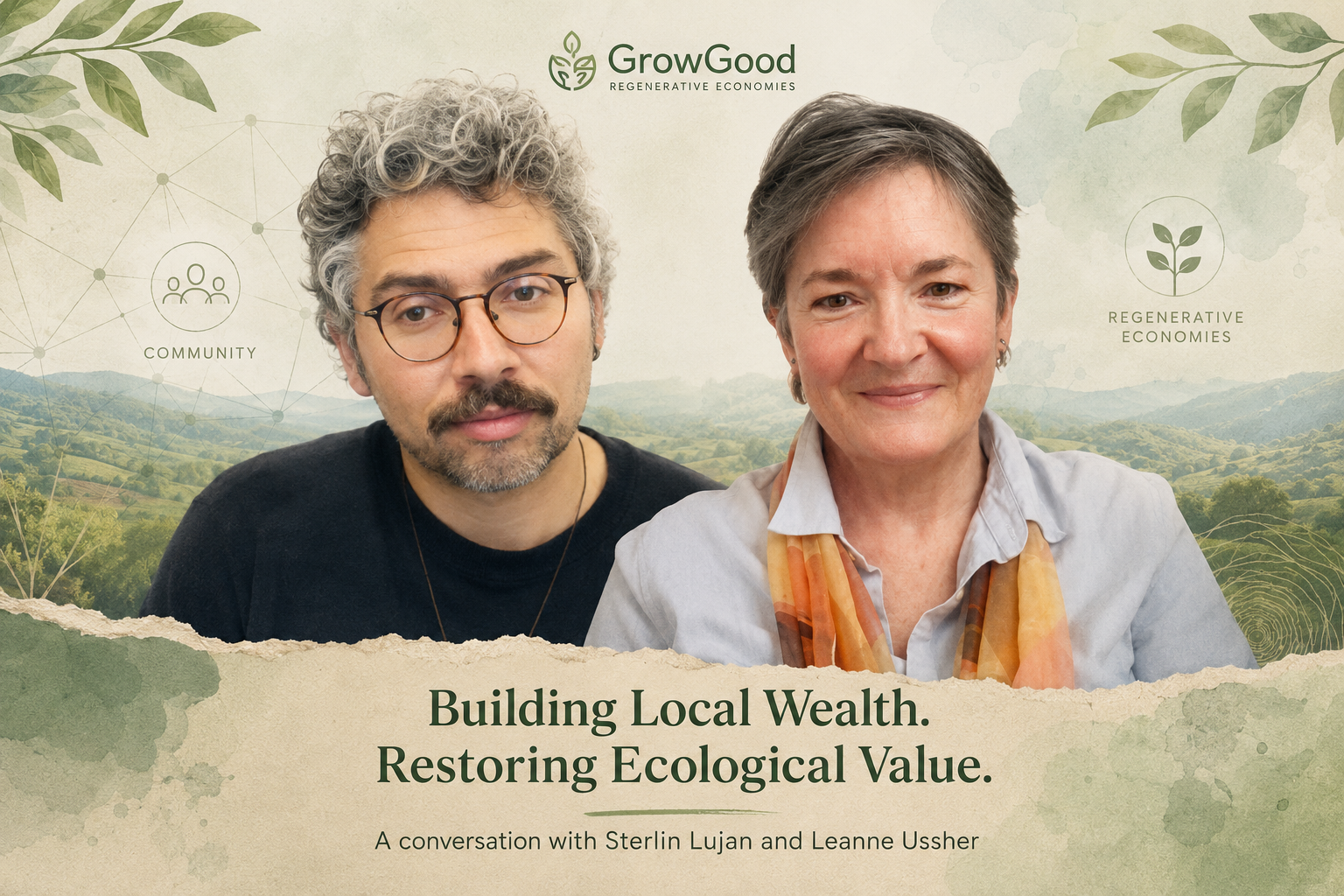
Guest Podcast with Host Sterlin Lujan
Introduction
What does a post-capitalist economy look like, and where does value actually live? In this deep-dive session from the Logos Thursday X Space, heterodox economist and monetary theorist Leanne Ussher joins host Sterlin Lujan to explore the frontier of community-owned economies.
The conversation traces a fascinating lineage of economic experimentation—from the Wörgl “miracle” during the Great Depression and the Sardex network in Sardinia to modern-day implementations like Will Ruddick’s Sarafu currency in Nairobi’s Kibera slum. Moving beyond theoretical frameworks, this discussion focuses on practical applications: mapping material, ecological, and human flows to reclaim value that mainstream economics is built to ignore.
Key Topics Covered:
- The three functions of money through a heterodox lens.
- The “leaky bucket” effect: How value drains out of local economies.
- Polycentric governance and the “Prisoner’s Dilemma” in community design.
- Modeling currency as a coordination layer for material flows.
Summarized Transcript
Featuring: Sterlin Lujan, Logos Moderator Dr. Leanne Ussher, Economist, GrowGood
Sterlin
Really happy to be here, guys. This is going to be an amazing space. After hearing about Leanne and her work, I became very curious about the overlap between what she’s doing and what we’re building at Logos — especially around hyper-local communities, governance, and local economic coordination.
Today we’re discussing community currencies, local economies, regenerative systems, and the role blockchain can play in supporting resilient communities.
Leanne is an economist working in the local community currency space, but her work extends beyond that into peer-to-peer coordination systems and regenerative economic infrastructure.
Really happy to have you here today, Leanne.
Leanne
Yes, I’m an economist — a heterodox economist — and also a dairy farmer. I’ve written a number of papers on community currencies, local currencies, and different monetary regimes ranging from global systems down to very local economies.
The complementary currency school of thought is generally not about replacing fiat currencies entirely. It’s more about pluralism — the idea that different currencies can serve different purposes.
In reality, we already live in a world with many forms of currency: reward points, airline miles, digital platform credits, and clearing systems. These all function differently even though they may still be denominated in fiat currencies.
The Three Functions of Money
Sterlin
Maybe it would help to define what we mean by “money” versus “currency.”
Leanne
Traditional economics usually defines money through three functions:
- Store of value
- Medium of exchange
- Unit of account
But historically there has never been a true consensus that one form of money must perfectly satisfy all three functions simultaneously. Economists like William Stanley Jevons argued that different forms of money could serve different functions. He added a fourth: standard of value.
This is important because there is often tension between a currency as a store of value and a currency as a medium of exchange. If people want to save and hoard it, they are less likely to circulate it.
The Leaky Bucket Problem
Sterlin
One idea you discuss is the “leaky bucket” problem — the idea that value constantly leaves local communities and concentrates elsewhere. How do local currencies address that?
Leanne
Any currency can fail if it’s poorly designed. The reason fiat currencies dominate is largely because governments require taxes to be paid in them. That creates demand.
But local systems can also create demand through membership obligations, reciprocal commitments, and governance structures. The key issue is usefulness. A local currency needs to help coordinate actual economic activity and circulate within the community. If it’s only backed by speculation or trust, it becomes unstable.
Historical Examples of Local Currencies
Leanne
Local currencies are not new. During the Great Depression, many rural communities in the United States created local scrip systems because national money had disappeared from local economies.
One famous example was the Wörgl experiment in Austria. The local government created its own currency during the Depression and the results were extraordinary: infrastructure improved, unemployment dropped, and local trade increased. It became so successful that the Austrian central bank shut it down.
Sardex and Mutual Credit
Leanne
A more modern example is Sardex in Sardinia. During the global financial crisis, liquidity fled the region, so businesses created a mutual credit system where trade credits between businesses became a shared local accounting network. The system is still functioning successfully today.
Sarafu and Community Currencies in Kenya
Leanne
Another important example is Will Ruddick’s work with Sarafu in Kenya. I visited Kibera in Nairobi where many people had abundant labor and skills but lacked access to national currency. The local currency allowed communities to coordinate exchange and activate underutilized resources.
But there was also a challenge: people often wanted to immediately convert the local currency into Kenyan shillings. That creates a prisoner’s dilemma.
Prisoner’s Dilemma and Local Coordination
Sterlin
So the problem becomes that if everyone defects and cashes out, the local economy weakens.
Leanne
Exactly. If people continue circulating value locally, the community becomes stronger through multiplier effects. But if everyone exits immediately into external currency systems, the local coordination breaks down.
That’s why governance and reciprocity matter. Will Ruddick eventually moved away from emphasizing “currency” and instead focused on what he calls commitment pools. The emphasis became reciprocity, multilateral coordination, social obligation, and cooperative exchange—rather than speculative accumulation.
Don’t Start With the Currency
Leanne
One of the biggest lessons I learned is: don’t start with the currency. Start with material flows, resources, production systems, ecological relationships, and human relationships. The currency is only a coordination layer.
The real value exists in the people, the ecology, the production systems, and the relationships between them. I’ve designed examples like a milk coin or a koala coin, but those only make sense within the context of the actual needs and resources of the community.
Polycentric Governance
Leanne
The goal isn’t isolation. The goal is distributed resilience. Small communities can self-govern more effectively because people know each other and understand the consequences of their actions.
But those communities should still connect with other communities. That creates what’s called polycentric governance: small autonomous groups cooperating together across networks.
GrowGood and Regenerative Infrastructure
Sterlin
Let’s talk more about GrowGood.
Leanne
GrowGood is focused on mapping value flows and building regenerative infrastructure. We’re creating open-source digital commons infrastructure for regenerative agriculture, food systems, supply-chain transparency, measure-report-verify systems (MRV), and ecological accounting.
The idea is to create interoperable systems that communities can adopt locally while still connecting globally. I often describe it as a mycelium layer supporting regenerative ecosystems.
Open Source and Digital Commons
Leanne
Digital infrastructure behaves differently from physical infrastructure because it becomes more valuable the more people use it. That’s why open-source systems matter. The goal is not to lock knowledge away in silos, but to create shared infrastructure that communities can build upon collaboratively.
Community Supported Agriculture and Circular Economies
Leanne
Community Supported Agriculture (CSA) systems are a great example of reciprocal local economics. Members purchase food production in advance, helping stabilize the farmer while sharing risk across the community. That creates direct reciprocity.
But we also want indirect reciprocity: where the broader network supports participants through coordinated exchange systems. This extends into machine-sharing circles, cooperative repair systems, resource pooling, and circular production systems.
Human Scale Governance
Sterlin
A lot of this also aligns with human-scale governance ideas. When systems become too large, coordination becomes difficult, incentives distort, and extraction increases. There’s also the issue of Dunbar’s number—the idea that humans can only maintain a limited number of meaningful social relationships. Smaller communities tend to produce stronger accountability and healthier game-theoretic incentives.
Closing Reflections
Sterlin
This conversation has been one of my favorites because it feels like we’re discussing real alternatives to extractive economic systems. We’re trying to build systems that reduce exploitation, strengthen local resilience, align incentives cooperatively, and reconnect economics with ecology and social relationships.
Your work is deeply needed right now, Leanne.
Leanne
Thank you. I think the important thing is to start small. Build local trust. Build reciprocal relationships. Coordinate resources. Then connect those systems together. That’s how resilient economies emerge.
Remainder of podcast was discussion with audience members.
Featured image by Darrell - Timber Frame Barn Raising on Flickr.
Comments
Be the first to comment! Reply to this post from your Mastodon/Fediverse or Bluesky account, or mention this URL in your reply. Your comment will appear here automatically via webmention.
Follow GrowGood on Mastodon/Fediverse at @growgood.org.au@growgood.org.au


