
GrowGood Mycelium
Part 1: Economics of the Digital Commons
GrowGood is an ambitious open-source digital platform built to empower farmers to reorient their practice towards regenerative agriculture. We are part of a movement and a broader shift toward planetary civics grounded in what Zehra Zaidi & Indy Johar (2024) describe as two defining realities:
Firstly, there is an awakening of planetary consciousness regarding the scale of planetary challenges. Groups of stakeholders have recognised that there is finite time to correct destructive pathways and have begun to experiment and generate new propositions.
Secondly, in computational advancements we may finally have the tools to match the scale of planetary challenges and build bold, ambitious models of care to repair and sustain our planet which can provide new insights and ways of thinking, being, learning and self-learning.1
Our open-source tool is a farm and food platform to track environmental externalities, measure-report-verify (MRV), and coordinate the use, production, and transfer of agricultural resources within and between farms, businesses, and communities.
GrowGood is building essential infrastructure for a new economy: a shared socio-ecological accounting system. As what Yochai Benkler (2006) describes as a commons-based peer production (CBPP)2 project, we are bringing together open-source volunteer developers, AgTech farm hackers, impact funders, ethical for-profit companies, ecological communities, researchers, governments, students and others to join this mission. You do not have to begin as “regenerative” to participate—our tools are open for anyone to use. However, we believe that once you join the ecosystem, the visibility created through shared infrastructure, transparency, and planetary consciousness encourages a different kind of participation—one shaped by tenderness, tentativeness, and care1, where coordination is guided not only by efficiency, but by responsibility to each other and to the living systems we depend on.
1. Engagement with GrowGood
For any organization building open source software, there are three essential pillars of engagement: mission, contribution, and use.
A. Mission for a Regenerative Food System
Across the planet, countless groups are working toward agroecology or regenerative agriculture. Farmers, gardeners, food hubs, businesses, universities, governments, scientists and communities—people who grow, process, eat, sell or study food are increasingly concerned about how our food is produced and who is stewarding the ecosystems they depend on.
For many, this is more than a job. It is a shared mission
- to build food systems that are accessible, safe, and nutrient-dense
- where agricultural work is meaningful and fairly compensated
- where ecosystems are restored through practices that strengthen soil health, biodiversity, and water retention
- for farming systems that move away from fossil fuel dependence and pesticides
- for shorter supply chains
- for agricultural knowledge that works the natural cycles of carbon, nitrogen, and water rather than against them
- protecting the autonomy of family farms through horizontal cooperation, agroecology and data sovereignty while building communities of trust, shared learning and polycentric governance.
Mission is the pillar in GrowGood engagement that makes the other two possible. It is the reason people contribute before there is trust, cooperate before there is reputation, and choose stewardship over extraction.
B. Contribution is Not Charity
Toyota executive Masato Endo 3 is adamant, contributing to open-source is not charity. Companies are not losing value by contributing, they are often buying resilience, security, speed, reputation, and long-term influence over the systems they depend on now or in the future. In this sense, contribution is a form of strategic investment. The return is not only financial, but operational and reputational: trust grows, maintenance declines, and the organization becomes part of the system shaping the future rather than merely consuming it.
Under the AGPL (a strong copyleft license) a for-profit company that redistributes GrowGood MRV digital infrastructure—for example by offering a GrowGood digital product passport (DPP) or an enclosed software as a service (SaaS) cloud platform—must share any improvements to the code back with the GrowGood community. This is not a punishment; it is an ecological design—ensuring that those who benefit from the commons also help regenerate and strengthen it.
This principle is not only ethical; it is also economically rational. A 2026 report by the Linux Foundation shows that contributions back to shared infrastructure yield a return on investment (ROI) of 200 to 500%3.
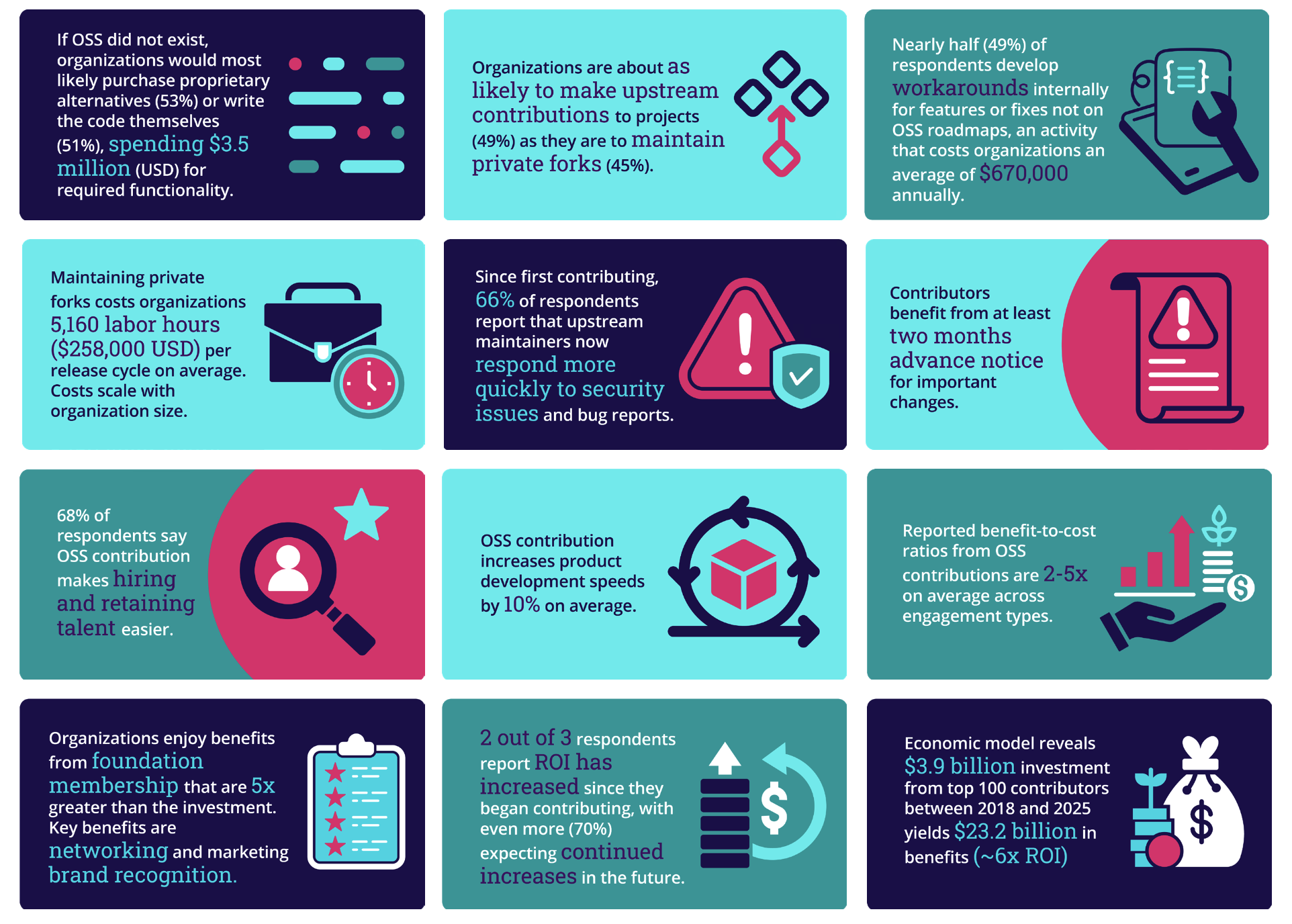
Source: The Linux Foundation, ROI for Open Source Software Contribution
‚ February 2026
The info graphic above summarizes benefits to the Linux commons from corporate contributions in kind and money: accelerates innovation, improves quality, and gives organizations influence over the infrastructure they will depend on, strengthens trust, improves responsiveness, helps attract and retain mission-driven talent and creates a more resilient ecosystem for everyone involved.
Those who do not contribute often pay more later—through higher maintenance costs, weaker influence, slower adaptation, and dependence on systems shaped by others. Contribution compounds over time: trust grows, reputation strengthens, and the organizations that help build the commons are better positioned within it.
GrowGood wants to flip the timing of this sharing and ask ethical corporations aligned with our mission, to ‚ “pay it forward” Rather than contributing only after commercial benefit is realized, companies can share developers now—when GrowGood needs support most, when their contribution can create the greatest impact, and when the return on their contribution will be reciprocated at the highest rate.
Contribution to the GrowGood open-source code can take three forms:
-
code contribution: python developers, flutter user interface, product passport engineers, APIs, certification tools, MRV systems, computer science student internships, and interoperability standards.
-
community contribution: grant writers, grant suggestions, designers, introductions to funders, blog writers, community organizers, farmers drafting workflows, certifiers improving MRV documentation, educators training new users, market hubs refining logistics standards, researchers validating ecological indicators, and food hubs helping onboard participants.
-
direct financial contribution: donations, crowdfunding, sponsorships, cooperative memberships, grants, infrastructure funding, and commercial users paying to sustain the commons they depend on, states wanting a glass box and ethical partners building their public infrastructure.
Like mycelium in a forest, those who draw value also strengthen the system that sustains them. The systems that endure are those where mutual contribution produces the best collective outcome. As open digital public infrastructure, GrowGood is sustained through commoning, mission-aligned contributions and planetary civics—not venture capital.
C. Use GrowGood
The GrowGood platform gives farmers and their upstream or downstream product network the infrastructure to record, verify, and coordinate across the value chain—from purchased inputs and on-farm activity to ecological stewardship and the final product.
Each resource can carry a digital product passport, creating a transparent and auditable history of how food is grown, transformed, moved, and valued. Labor, biodiversity, soil health, shared knowledge, and stewardship can be recorded alongside financial transactions, making invisible contributions, visible and accountable.
Growers have the freedom to create their own bespoke certificates; curate, own and share their data; adopt workflows; or adapt their practices to meet agreed quality and regenerative standards. The accounting schema improves transparency, knowledge, trust and coordination across the food system.
The value proposition is simple: greater accountability, stronger trust, verified regenerative claims, easier compliance, data sovereignty, better coordination, local autonomy through local governance and new opportunities for shared value creation.
Even before the full rollout, future users can join this mission, volunteer, sign up, share knowledge, pilot and help us grow adoption.
2. Commons Sustainability
Commoning itself can be regenerative. Participation, cooperation, and social norms can reinforce collaboration and deepen the level of coordination. Commons Based Peer Production depends on trust, aligned expectations, reciprocity and governance.
A. Trust
Contributors often improve a shared project and cooperate not because they expect direct payment from the next user, but because they believe in the project and know that participation builds trust, learning, reputation, and future opportunity. A farmer shares knowledge, a developer improves code, a certifier improves documentation—each trusting that the health of the commons will return value over time - to them or someone or something else.
B. Aligned Expectations
Cooperation survives because communities establish expectations: contribution is good, extraction without reciprocity is bad. These norms discourage free riders and create cultural legitimacy around supporting the commons. If companies already see the value in GrowGood and want to use it in the future, then they can contribute now, because expectations are aligned.
C. Non-equivalent Reciprocity
Not every contribution can or should be measured in equal financial or market terms. A farmer’s field knowledge, a maintainer’s late-night debugging, a chef’s recipe, or a university’s verification work may all create different forms of value. Accepting unequal exchange makes cooperation evolutionarily stable. It avoids the awkwardness of constant self-promotion and recognition alone creates reputation—not self-valuation—to signal worth. Individuals and organizations with strong reputations for stewardship are more likely to receive support, collaboration, and trust from others.
D. Governance
Communication and fairness are critical to a stable commons. Cooperation does not sustain itself automatically through decentralization alone—it requires shared rules, transparent decision-making, and the ability for participants to review, challenge, and improve how the system operates.
As Elinor Ostrom (2009) 4 showed in her work on commons governance, successful commons depend on clearly understood boundaries, collective participation in rule-making, and trusted mechanisms for monitoring and accountability. Governance is not control from above, but the capacity of participants to steward the system together.
For GrowGood, this means contributors must be able to see how decisions are made, how standards are set, how value is allocated, and how disputes are resolved. Local autonomy must exist alongside shared global standards. Governance creates legitimacy, and legitimacy makes contribution durable.
3. The New Commons Economy
If capitalism’s strength lies in making value invisible through commodification, GrowGood’s power is the opposite: making relationships visible and adding back context—who grew it, how it was grown, where it moved, how it was processed, who benefited.
In building the GrowGood digital commons, not everyone writes code—but everyone can contribute. A farmer may never directly repay the developer who builds their certification workflow, just as no single tree repays the mycelial network beneath the forest floor. Some take more than they return, and some parts of the system fail, yet the network endures because enough participants continue to feed and protect the conditions that sustain all life above it. Commons work the same way: prosperity does not depend on perfect reciprocity from every individual, but on enough ongoing contribution to keep the whole system alive and regenerative.
GrowGood will remain free and open source because it is not simply software—it is shared public infrastructure, the mycelium beneath a regenerative economy. By making visible the flows we value, GrowGood will create the conditions for wider trust, cooperation, and a transition toward a more ethical society rooted in planetary civics—the understanding that our responsibilities extend beyond individual gain to the health of communities, ecosystems, and the planet itself.
Your contribution in this origin phase is essential. As David Bollier (2014) writes:
The beauty of commons is that we can build them ourselves, right now. But the bigger challenge is, can we learn to see the commons and, more importantly, to think like a commoner?"5
Commons-based peer production depends on asynchronous and indirect reciprocity: people contributing in different ways and at different times to keep the system alive and evolving. Without that reciprocity, the commons weakens—developers burn out, maintainers disappear, trust declines, and the possibility of a thriving regenerative ecosystem for farmers, communities, and the planet is lost beneath passive consumption.
With widespread enthusiasm, participation, contribution, and shared stewardship, GrowGood becomes far more than software. It becomes part of the essential infrastructure for a new commons economy: a shared metabolic system where trust, value, and responsibility circulate like nutrients through living soil.
Join our Discord Channel
Citations
-
Zaidi, Z. & Johar, I. (2024) Position Paper for the Planetary Civics Inquiry: A New Framework for Planetary Futures . Planetary Civics Inquiry. ↩︎ ↩︎
-
Benkler, Y. (2006). Wealth of Networks : How Social Production Transforms Markets and Freedom . Yale University Press. ↩︎
-
Lawson, A & Boysel, S. (2026) “ROI for Open Source Software Contribution: Insight from the Open Source ROI Survey and Economic Model ” forewords by Chris Aniszczyk, Hillarie Prestopine, and Masato Endo, The Linux Foundation, February 2026. DOI: 10.70828/XSJC5531 ↩︎ ↩︎
-
Ostrom, E. (2009) “A General Framework for Analyzing Sustainability of Social-Ecological Systems.” Science 325:419-22.(2009).DOI:10.1126/science.1172133 ↩︎
-
Bollier, D. (2014) Think like a commoner : a short introduction to the life of the commons . New Society Publishers, Gabriola Island, BC, Canada. ↩︎
Featured image by Kirill Ignatyev (Bushman.K) on Flickr.
Comments
Be the first to comment! Reply to this post from your Mastodon/Fediverse or Bluesky account, or mention this URL in your reply. Your comment will appear here automatically via webmention.
Follow GrowGood on Mastodon/Fediverse at @growgood.org.au@growgood.org.au


