
Doughnut Economics and GrowGood
- Leanne Ussher, Leo Gaggl
- Vision , Economics , Open source
- January 23, 2026
Introduction
Kate Raworth’s “Doughnut Economics” presents a compelling model for 21st-century prosperity, one that rejects the endless pursuit of GDP growth in favour of a more balanced goal. The “Doughnut” itself is a visual framework representing a safe and just space for humanity. It consists of two concentric rings:
- The Social Foundation (Inner Ring): This outlines the basic standards of living—such as food, water, housing, and political voice—that no one should fall below.
- The Ecological Ceiling (Outer Ring): This represents the nine planetary boundaries, such as climate change and biodiversity loss, that humanity must not overshoot to protect Earth’s life-support systems.
The goal is to operate within the Doughnut’s green ring: the space where we can meet the needs of all people within the means of the living planet.
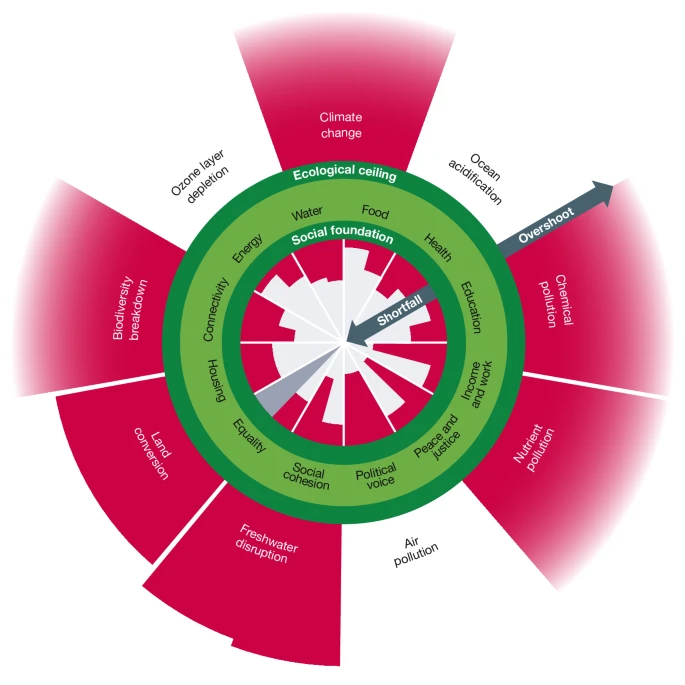 Image Source: https://www.nature.com/articles/s41586-025-09385-1
This document explores how an entity, and thereby an economy, might still grow but in a good way by considering the GrowGood platform, with its foundational use of the Valueflows standard. While we are still building this tool, we can already imagine how it will be aligned with the Doughnut view and can be made tangible and actionable through specific visualisations in the application’s dashboards and reports.
GrowGood, Valueflows, and the Seven Ways to Think Like a 21st-Century Economist
Raworth proposes seven fundamental shifts in economic thinking. GrowGood’s architecture and features, as described in the project’s README.md inherently support these shifts.
1. Change the Goal: From GDP to the Doughnut GrowGood moves the goal from maximising simple yield (the agricultural equivalent of GDP) to optimising for a balanced set of outcomes. By tracking the entire product lifecycle—from seed to sale, including all inputs and environmental interactions—the platform provides a holistic view of farm performance that is perfectly suited to the multi-dimensional goal of the Doughnut.
2. See the Big Picture: The Embedded Economy The README.md describes GrowGood as a “economic network” that facilitates “peer-to-peer coordination.” This directly reflects the Doughnut’s principle that the economy is embedded within society and nature. The use of Valueflows as an interoperable standard is the language that enables this network to function, allowing the farm to interact with suppliers, customers, and partners in a resilient, interconnected food system.
3. Nurture Human Nature: Social and Cooperative GrowGood is designed for collaboration. Features enabling “demand-driven production” and peer-to-peer coordination foster a cooperative, rather than purely competitive, environment. The system is built for multiple users, acknowledging that a farm is a social entity.
4. Get Savvy with Systems: Complex and Dynamic The visual, node-based editor for creating “Valueflows Recipes” treats the farm as a complex, dynamic system, not a linear factory floor. This systems-thinking approach allows farmers to model and understand the intricate web of processes and feedback loops that constitute their operation.
5. Design to Distribute: Distributive by Design By being JSON-LD native and built on the open Valueflows standard, GrowGood helps distribute power. It gives farmers ownership and control over their own data, reducing reliance on proprietary platforms. This can facilitate direct-to-consumer sales, local marketplace integration, and fairer supply chains, distributing economic value more broadly.
6. Create to Regenerate: Regenerative by Design This is one of the strongest alignments. The README.md explicitly mentions “regenerative grazing,” incentivising “regenerative practices,” and integration with “Measure, Report, and Verify (MRV) frameworks.” Valueflows provides the granular tracking of resources, processes, and outcomes necessary to prove and improve regenerative practices. It allows a farm to account for not just what it produces, but how it enhances (or degrades) the ecosystem it is part of.
7. Thrive, Don’t Just Grow GrowGood helps a farm to thrive in multiple dimensions—ecological health, social contribution, and economic viability—rather than simply growing in revenue. The detailed, auditable data trail allows a farmer to define what “thriving” means for their unique context and track progress towards that goal, whether it involves monetary gain,
an accumulation of regenerative resources or greater biodiversity.
Visualising the Doughnut in GrowGood
To make these concepts intuitive and actionable, GrowGood’s UI can directly incorporate the Doughnut model.
The “Farm Doughnut” Dashboard Widget
A central widget on the Administrator and Operational dashboards could be a radial “Doughnut” chart that provides an at-a-glance overview of the farm’s performance against key social and ecological metrics.
-
Outer Ring (Ecological Ceiling): Segments could represent key planetary boundaries relevant to agriculture. The visualisation would show the farm’s impact relative to a pre-defined, science-based, or regionally-appropriate target.
- Climate Change: Metric tons of CO2e emitted vs. sequestered. Data from lifecycle analysis of inputs and on-farm sequestration models.
- Water Use: Litres of water used vs. the farm’s allocated water budget or regional sustainable use levels. Data from IoT sensors on pumps and water tanks.
- Biodiversity: An index score based on observed species, habitat preservation, and pollinator-friendly practices. Data from manual observations or landscape audio files, logged as events .
- Nutrient Loading: Kilograms of nitrogen and phosphorus applied vs. a safe application limit. Data from input logs in Valueflows.
-
Inner Ring (Social Foundation): Segments could represent the farm’s contribution to the social fabric.
- Local Sourcing: Percentage of inputs (seeds, compost, etc.) sourced from within a defined local radius. Data from supplier information in Valueflows events.
- Local Distribution: Percentage of products sold to local markets. Data from customer information in Valueflows events.
- Fair Labour: (If applicable) Hours worked and wages paid compared to living wage standards.
- Community Contribution: Value of food donated or hours spent on educational activities.
The goal for the farmer would be to keep all indicators within the “safe and just space” between the rings. The UI would use clear colours (e.g., green for “safe,” red for “overshoot” or “shortfall”) to make performance immediately obvious.
Measurements would be place-based, standardized but approved through community input.
Impact Gauges in Reports
Beyond the main dashboard, mini-doughnuts or “impact gauges” could be embedded in other views:
- Product Lifecycle Report: When viewing the complete history of a product (e.g., a batch of carrots), a small doughnut could show the specific environmental and social footprint of that batch. This would allow for comparing the “Doughnut cost” of different products or growing methods.
- Recipe Builder: As a farmer designs a “Valueflows Recipe,” the system could estimate the future impact of that process, providing immediate feedback on how different choices (e.g., which fertiliser to use) affect the farm’s overall Doughnut performance.
By integrating the Valueflows standard at its core, GrowGood is perfectly positioned to be a practical, powerful tool for implementing Doughnut Economics at the farm level. It provides the detailed measurement and management capabilities required to move from abstract theory to concrete, data-driven action.
The visualisations proposed here would translate the complex, interconnected data captured by Valueflows into an intuitive and actionable guide, empowering farmers to see, understand, and manage their role in creating a regenerative and equitable food system.
Featured image by Conall on Flickr.

